Slow scenes from an ancient, barely touched village in Nepal.
My stay in a rural village in Chitwan, Nepal, sparked an awakening to the value of a simple, farm lifestyle.
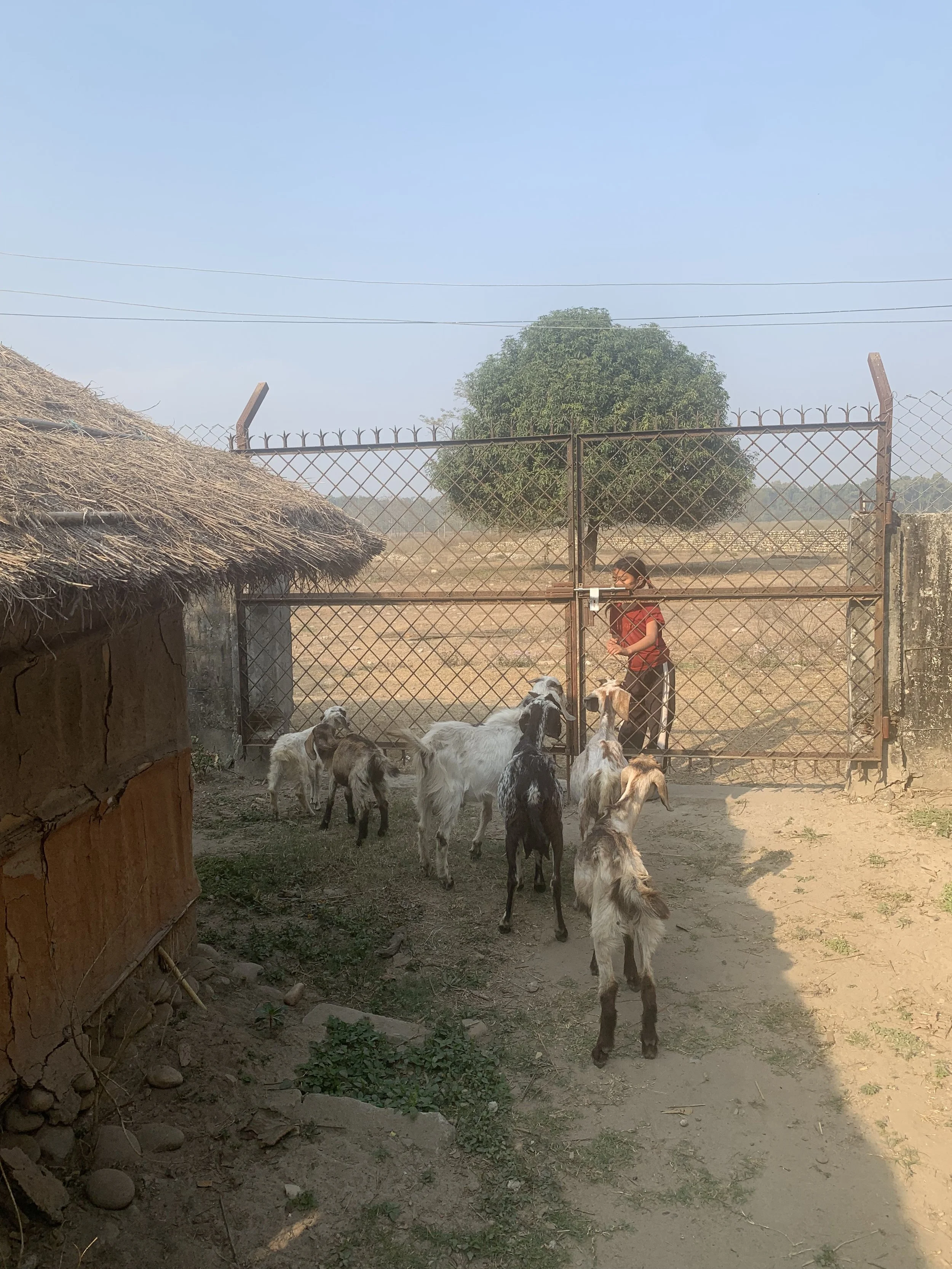
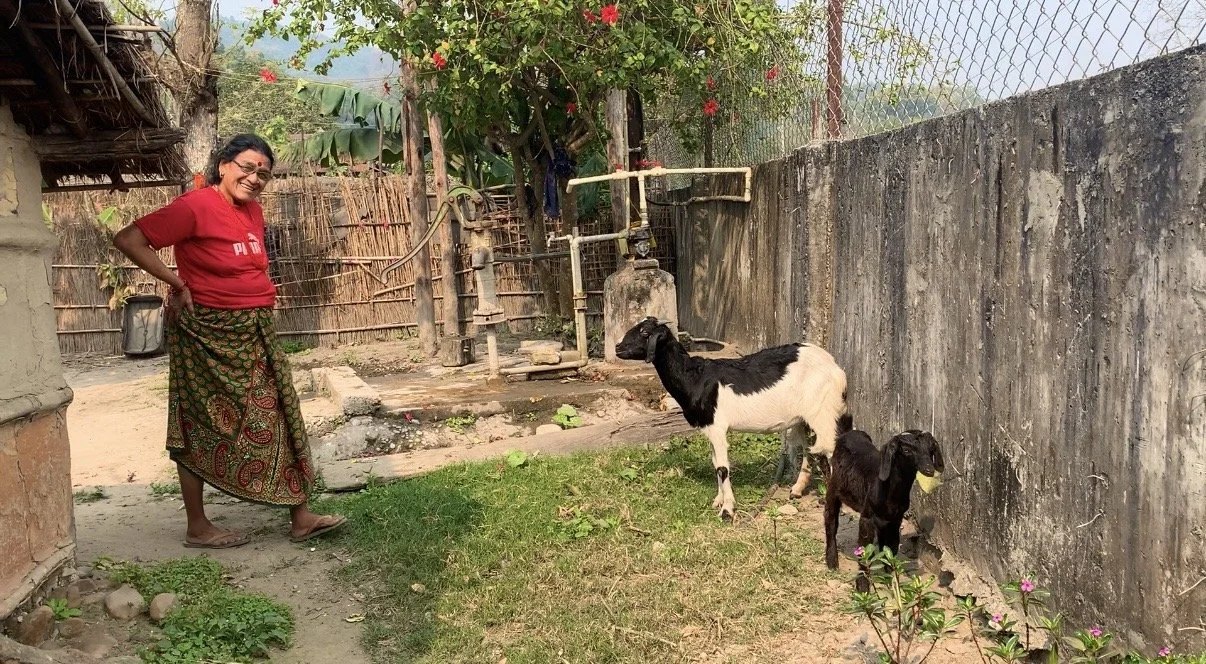
I woke up to unfamiliar sounds of exotic birds from the jungle nearby, and the crowing of Red Junglefowls that signalled it was very early morning in a rural location. A short time later, the crunching sounds of goats munching on leaves could be heard through the window (a hole in the mud house with a metal net covering it), and gleeful shouts of a village woman following them: “la! la!” (“okay” or “all right”). Peering through the window, I saw her shaking the branches of a nearby mango tree for delicious leaves to fall for the goats. I was enclosed by mud walls, instead of cement and brick, and a bamboo roof, all of which were fascinatingly effective in keeping the cold morning air from the outside away and maintaining a cosy inner haven. Every morning was exactly like this, a lovely awakening from slumber pierced with the joyful sounds of the natural world right outside my door.
Each day entertained me with the same heartwarming sights of the village I was staying in. Herds of buffalos slowly walked out of their designated huts (which were next to the larger houses of the village people) in adorably polite manner, to graze on the enormous, stunning fields, with their village owners guiding and keeping eye on them. Watching them slowly move across the fields at daytime was very peaceful.
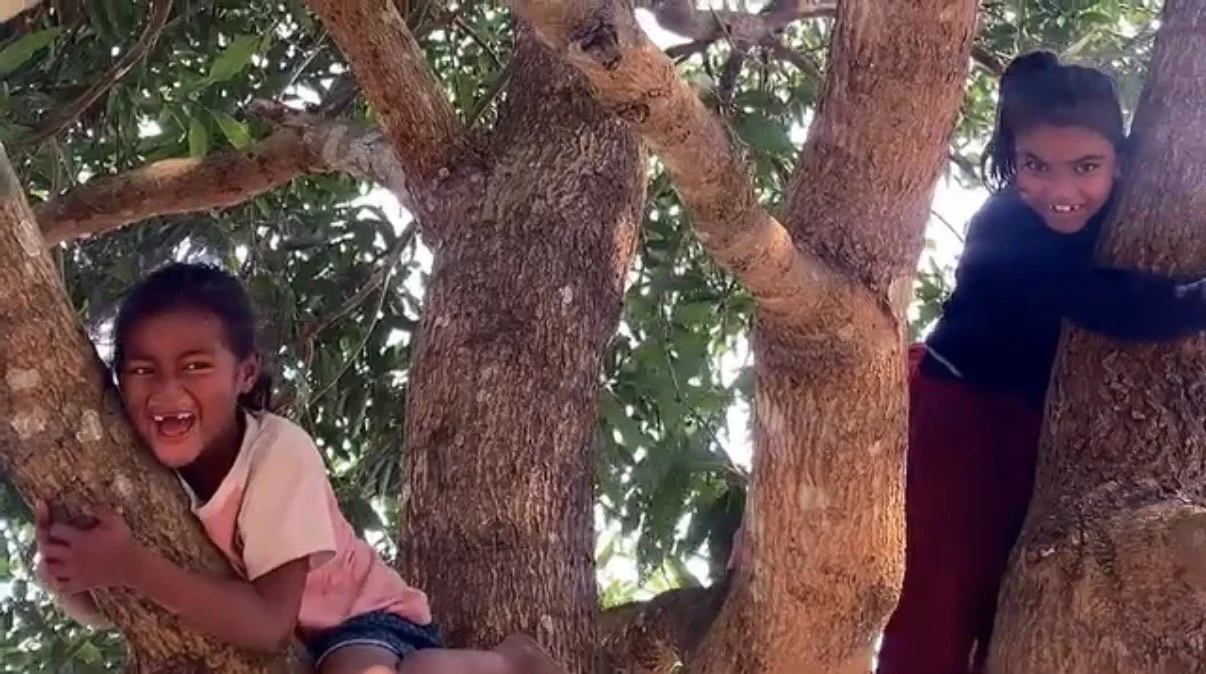
Children could be heard up in the mango trees in the middle of the day, gleefully playing and singing while still in their pyjamas. Every time they spotted me relaxing at the guesthouse or walking by outside, they’d shout “Didi (sister)! Come please!”, begging me to play with them too. I’d drop whatever I was doing to play with them and join in on their infectious joy - they would not take no for an answer to play! They loved to show me their dance moves, encourage me to climb the tree with them, and request that I teach them English.
Walking through the village revealed to me charming displays of mud houses for the villagers with smaller huts for the village animals. Chickens had the smallest huts, while buffalos had huts larger in size. Giant straw piles as food sources for the animals towered next to the huts.
Many of the families had not only their own chickens and buffalos, but also goats and dogs. What was too cute to handle was seeing many baby chicks, baby goats and puppies roaming or running around in the front of the houses. Each house was like a zoo! I also found it humorous how long the goats and buffalos would stare at me for while filming them. They knew I was not from this place.
Villagers were seen out on the fields every day doing simple tasks: fishing, gathering natural materials (bamboo, wood and straw), or leisurely walking with their animals. At other times, they were seen: at their homes cooking, socialising with neighbours within the village, or venturing into the mysterious jungle next-door.
Whenever I stepped out of the guesthouse for a walk, village dogs excitedly ran towards me, wanting to join in on my escapades and indulge in my hugs and pats. They loved to come along with humans for a walk, as if it gave them a feeling of safety from something while merrily exploring.
Every day finished with a gentle sunset over the jungle, and the sight of buffalos having their last graze on the fields before calmly walking back home with their owners.
Time moved very slowly here. There were no disrupting, mechanical sounds of loud traffic (except for the occasional movements of the local tuktuks and tractors), only the healing sounds of birds, buffalos, goats, dogs, cats, insects and village people. Nature moved at its own unhurried pace each day. There was no feeling of pressure to do anything. It was simply enough just to watch the beauty unfolding moment after moment.
Tranquil this ancient village was. There was also an enticing air of mystery and mysticalness to it. Stories of encounters with dangerous animals from the forbidden jungle, and mythical tales of giant beings who had lived in the village long ago, added to its already charming vibe.
One of the locals, a very friendly young man who always waved and came over to sit with me and my boyfriend, eagerly told us in Nepali about shocking stories of murder involving dangerous jungle animals roaming into the village. Since my boyfriend can speak Hindi, which is similar to Nepali, he was able to translate much of what the village man was expressing. A killer elephant who stormed into the mud houses for food - with a murder count of over 40 people. Vicious tigers who battled against the courageous village dogs who were defending the village. Rhinos who with their rock-hard skin could fatally charge at you if you got too close. Some nights, I heard the village dogs barking wildly, a startling sign that they were possibly in the middle of a life-threatening battle against unwanted intruders.
A giant well inside the jungle, not far from one of the entrances, carried a story of a giant being from long go who had built the well in just one day. Myth has it that the giant`s name was Bheem, and that he was one of five brothers (the “Pandavas”) who had fought in an epic battle (the “Mahabharata) and found exile in this village.
The truth is, though, that there is so much more to the jungle than the frightening danger of some of its animals and the captivating stories of mythical beings who had lived there long ago.
Walking into the heart of the jungle one day, with a local guide, the lush green trees, sounds and sights of exotic birds, and vivid ponds, were alluringly beautiful, and peaceful. It evoked within me a feeling of long-lost home, rather than fear. Humans have been living in natural settings like this for so long, in coexistence with nature and its wildlife. It was like stepping back in time to an untouched and primal paradise.
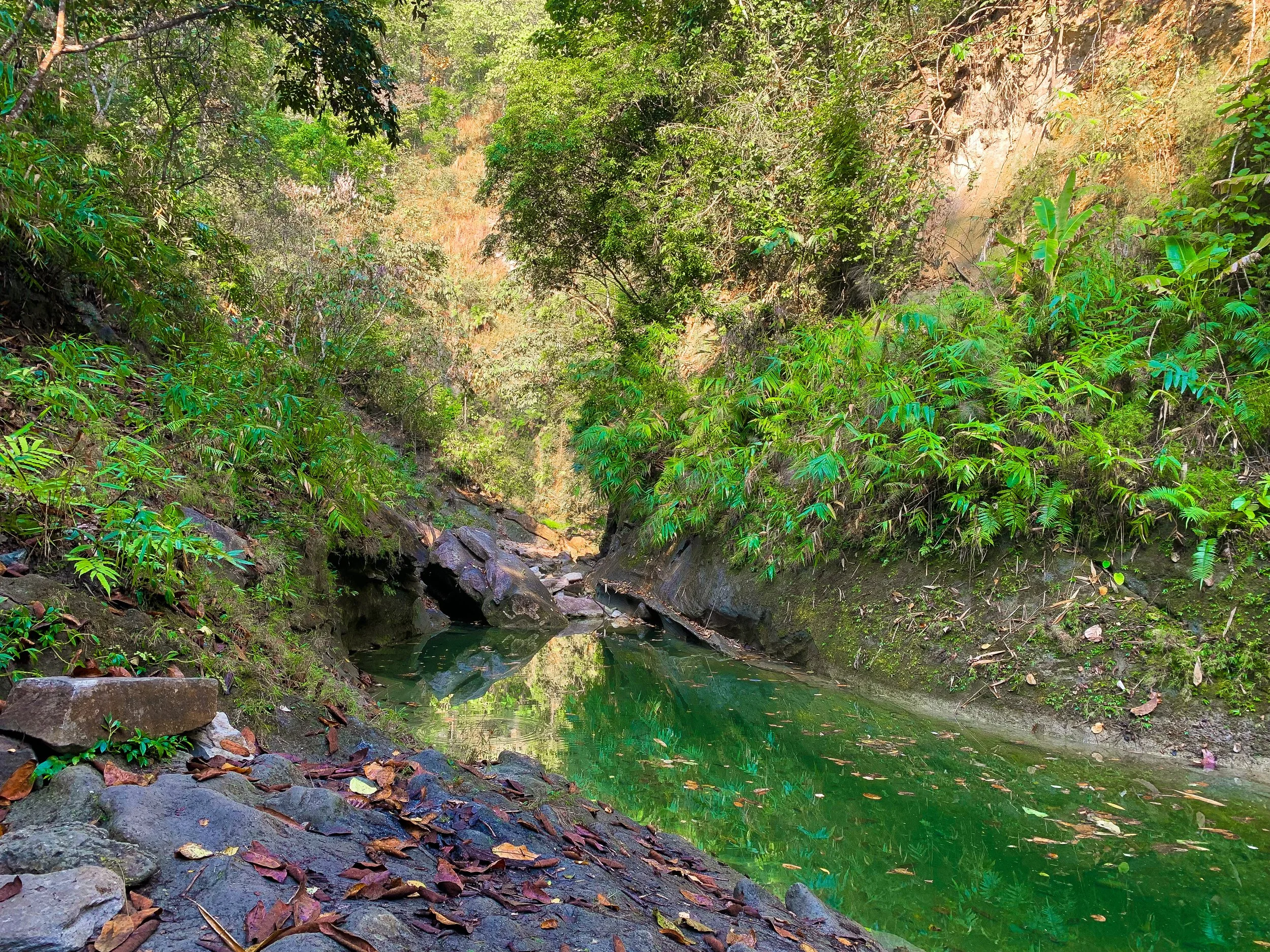
The village guide often stopped at moments to scan the vast beauty of the jungle, in awe, and with pride that this was his home.
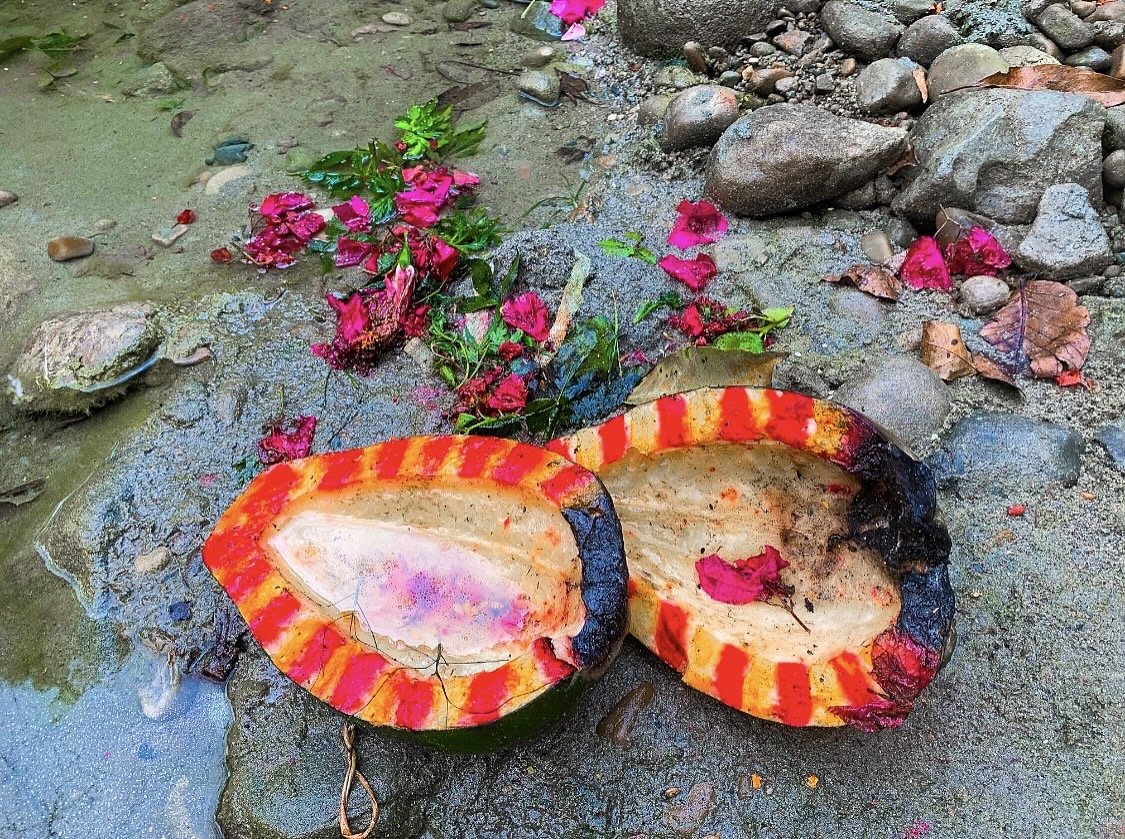
We stumbled across painted coconuts by the water, surrounded by flower petals ~ a beautiful offering to the Hindu god Shiva.
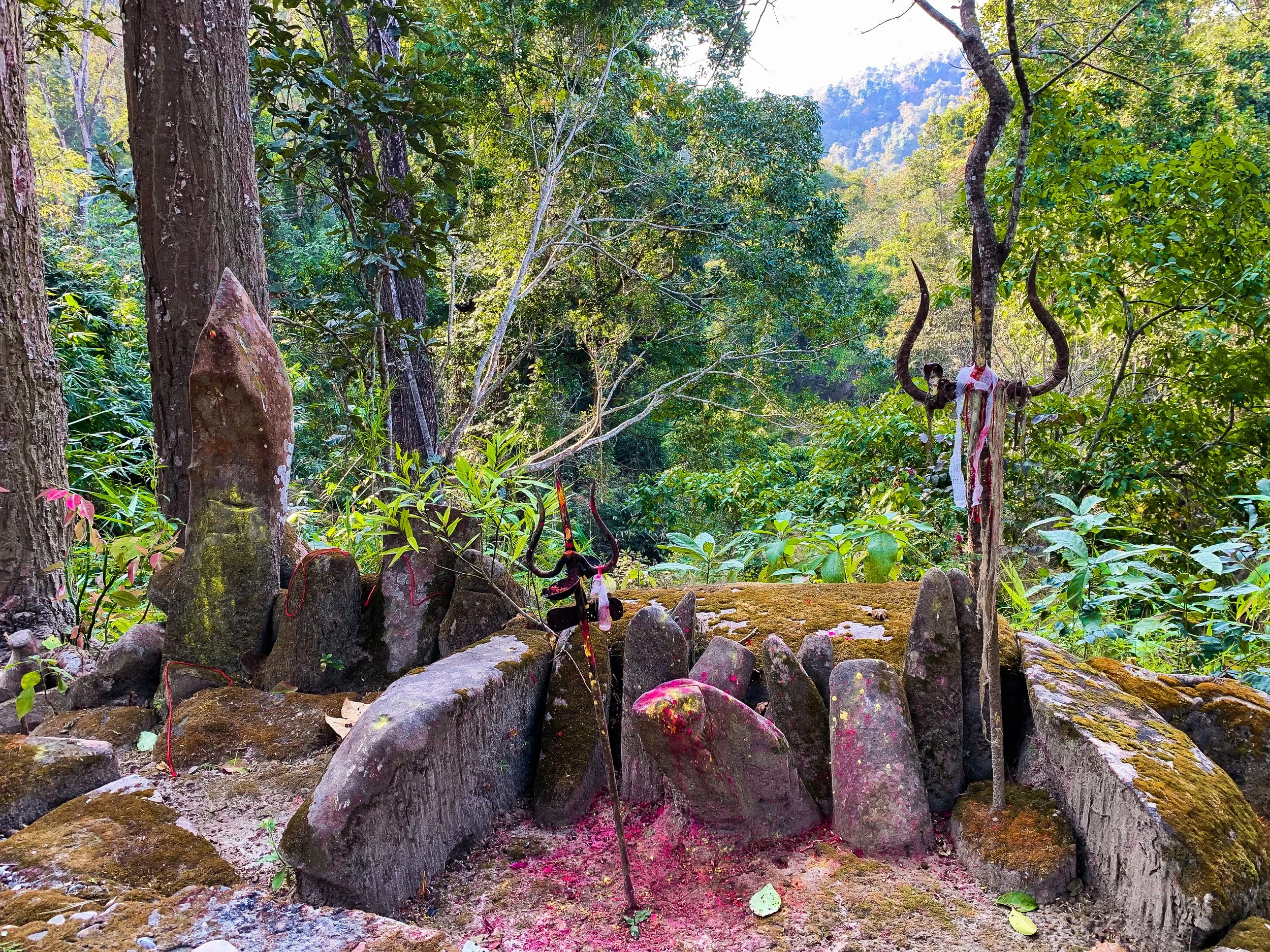
Deeper into the jungle was found a shrine dedicated to Shiva. It was an assortment of tall rocks (representing the phallus of Shiva) with colourful paint, flowers, and trishuls standing majestically.
Experiencing the rural ways of Nepal was a life-changing and spiritually transformative experience for me. I was born and raised in a city in Australia, a beautiful country in terms of its beaches, bushland and unique wildlife, the relaxed friendliness of many of its people, and the financial opportunity it offers for people. However, for a long time I had felt an unhappiness within my heart living in a highly modernised and individualistic Western culture. Where I come from, life moves very fast and there is social pressure to do more, have more and become more. Great focus is on going to university or trade school, building a career, and earning sufficient money to buy all the expensive things needed to survive. There is a feeling of competitiveness, materialism, and self-centredness within the West that I truly do not like.
As a highly sensitive and spiritual woman, my heart was yearning to move towards a different way of being: one of great simplicity, minimalism and harmony with nature, in which daily tasks that nourish the body and the home are prioritised as the real work of the day (cleaning, cooking, caring for animals and the family, sourcing natural materials for the house), and in which the feeling of community and spirituality are strongly intact. In such a life, there is great respect for and coexistence with the land. Nepal answered my yearning by showing me how beautiful and achievable the kind of life I wanted really is. It has now become a dream for me to continue to live such a life for myself in the future.
The people of the village in Chitwan which I stayed in got by easily with what they have. They sourced much of what they needed from nature. And they were proud and happy.
What makes this reality even more precious is the fact that I saw modern changes slowly popping up. Solar panels were on some roofs, and new houses were being built with cement instead of mud. Villages like this one won’t stay the same for too long
On top of this, many young Nepali people do not share the satisfaction of living a slow, farm life as the older people do. Instead, they dream of “making it” abroad– they desire to earn more money in a foreign setting that provides greater financial and career opportunities.
A young man in his 20s who was a tractor driver in the village exclaimed that he once left the place in search of a greater life abroad, but later came back after realising that he already had everything in his home village.
They would be shocked to learn that someone like me who comes from a place of privilege actually dreams to instead live a simpler, rural life just like theirs… filled with the simplest of joys.
When the moment came to leave the village on the last day of my stay, to journey onto my next destination in Nepal (Pokhara), I was sitting inside a tuktuk with my suitcases and a heavy heart from how much this village had touched me. The last sights of the village were the most heartwarming of all. Dogs ran up beside the tuktuk to say goodbye, goats and buffalos held their gaze, and children waved. I knew that this was not the end but that my life had opened up to a beautiful new beginning. I had started dreaming big to make such a simple, heartwarming life more embedded in my own future.
